
5 Best Chicken Coop Heaters 2027 (Safe Flat Panels, No Heat Lamps)
The 5 best chicken coop heaters in 2027 are:
Personally, my top pick is the Cozy Coop.
It is a 150-watt flat radiant panel with no bulbs, it is ETL-listed with a built-in thermal protector, and you can mount it on the wall or let it stand.
If you keep chickens, you probably worry about them on the coldest winter nights. Should you heat the coop or not, and if you do, how do you do it safely?
Here is the good news: healthy adult chickens usually handle cold well, as long as the coop is dry, draft-free and ventilated. But in extreme cold, with chicks, or with sick or molting birds, a safe heater can really help.
On my list, you will only find flat radiant panels and an overhead infrared heater, no heat lamps. After the reviews, there is a quick comparison, a guide on when your flock needs heat, safety tips and answers to common questions.
Quick note: I am not a vet. If you have questions about your flock’s health in winter, ask your vet.
Cozy Coop

Company: Cozy Products
Price: $$
The Cozy Coop is a flat panel heater made for chicken coops, and it is my top pick. It is a radiant panel, 150 watts, with no bulbs at all.
That alone makes it a much calmer choice for a wooden coop full of straw than a heat lamp.
Radiant heat warms the birds and surfaces in front of the panel, instead of trying to heat all the air in a drafty coop.
Your chickens can sit near it when they feel cold and move away when they don’t, which is exactly how I like a coop heater to work.
For safety, it is ETL-listed and rated zero clearance, per the listing.
It has a built-in thermal protector, a protected cord and two ways to switch it: a large ON/OFF switch on the panel and a second switch in the cord. That in-cord switch is handy when the panel is mounted high on the wall.
You can mount it on the wall or let it stand on its own with the included stand. The surface gets up to 170°F, so mount it where your birds can’t roost right on top of it and where bedding can’t pile up against it.
The listing says it is safer than brooders and heat lamps, and that it uses about 13% of the energy of a 1,500-watt space heater.
At 150 watts, it is a gentle heater for a small to medium coop. For most backyard flocks that need a little help on the coldest nights, this is the one I would start with.
What I like:
- A flat panel with no bulbs.
- ETL-listed, with a built-in thermal protector.
- Wall mount or free standing.
Features:
- 150 watts, radiant flat panel.
- ETL-listed, rated zero clearance, built-in thermal protector.
- ON/OFF switch plus in-cord switch, protected cord.
- Wall mount or free standing with stand; surface up to 170°F.
Keep in mind:
- The surface gets hot, so keep birds from perching on it and keep bedding away.
- It has an on/off switch, not a thermostat. Add a thermostat plug made for heaters if you want it to turn on only when it is cold.
Best for: Most backyard coops

Sweeter Heater OH11x40
Company: Sweeter Heater
Price: $$$
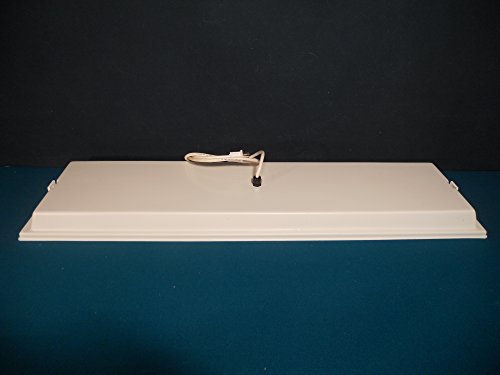
The Sweeter Heater is the premium pick on my list. Instead of standing on the floor or hanging on the wall, it mounts overhead, and the infrared heat comes down onto your birds from above.
The brand says it gives uniform heat with no hot spots. That is a big deal in a coop, because chickens crowd into the warmest spot. With more even heat, the shy hens get to share the warmth too.
The OH11x40 is the 150-watt overhead model. It comes with a chain and hooks, so you can hang it from the ceiling of the coop at the height you want. Overhead mounting also keeps it off the floor, away from the litter your chickens love to scratch around.
For safety, it has an internal thermostat that shuts it off automatically if the heat can’t escape, for example if something ends up covering it. Sweeter Heater says its heaters have been customer-tested since 1995, so this is a brand with a long history in animal heating.
There are other sizes too, like a 100-watt side-mount model and a 50-watt model, so if your coop is small or you want to mount it on a wall, check those.
It costs more than the flat panels, but if you want even heat from above and a heater that stays out of the way, this is a great choice.
It is also a nice option if your coop floor is small and every inch of space counts, because nothing sits on the floor or the walls.
What I like:
- Even heat with no hot spots, per the brand.
- Overhead mount, chain and hooks included.
- Automatic shut-off if heat can’t escape.
Features:
- 150 watts, infrared.
- Overhead mount, chain and hooks included.
- Internal thermostat: shuts off if heat can’t escape.
- Other sizes: 100 W side mount, 50 W.
Keep in mind:
- You need a sturdy ceiling or beam to hang it from.
- Hang it high enough that birds can’t fly up and roost on it.
Fair warning: it is the most expensive heater here, about three times the price of the flat panels.
Best for: Even overhead heat with no hot spots
Farm Innovators 2-in-1
Company: Farm Innovators
Price: $$
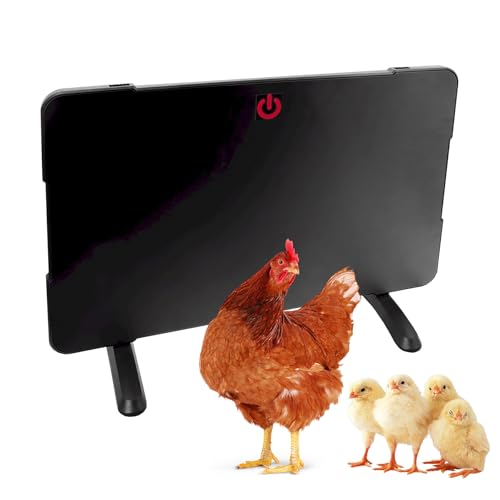
Farm Innovators is a name many chicken keepers already know from heated waterers, and this 2-in-1 radiant panel is a clever one. It works as a coop heater for adult birds and as a brooder for chicks.
In coop mode, it runs at 200 watts. You can stand it, hang it, mount it on the wall or lay it horizontally, and the listing says it also works in a shed. That flexibility helps if your coop has an odd layout or very little wall space.
In brooder mode, it drops to 50 watts, and you can set it at 3 heights: 3.5, 5 or 6 inches.
Chicks walk under the panel to warm up and walk out when they are warm, a lot like they would with a mother hen. As they grow, you raise it.
For safety, it is ETL listed, has a thermal protector and is certified zero clearance, per the listing. There is an inline switch on the 8-foot cord, so you can turn it off without reaching behind it.
The listing says it uses 87% less energy than a 1,500-watt heat lamp. If you hatch or buy chicks every spring and also want help for your adult flock in winter, this one heater does both jobs, which saves money and storage space.
I also like that it comes from a brand chicken keepers already trust for winter gear. If you already use a Farm Innovators heated waterer, this panel is an easy match for your coop.
What I like:
- Two heaters in one: coop and brooder.
- Many ways to mount it.
- An inline switch on an 8-foot cord.
Features:
- Coop mode: 200 W; stand, hang, wall or horizontal.
- Brooder mode: 50 W at 3.5, 5 or 6 inches.
- ETL listed, thermal protector, certified zero clearance.
- Inline switch on an 8-foot cord.
Keep in mind:
- Like the Cozy Coop, it uses a switch, not a thermostat.
- In brooder mode, watch your chicks for the first days: crowding under the panel or staying far from it tells you to adjust the height. If you are worried, ask your vet.
Best for: Keepers who raise chicks too
Chickcozy Smart
Company: Chickcozy
Price: $$
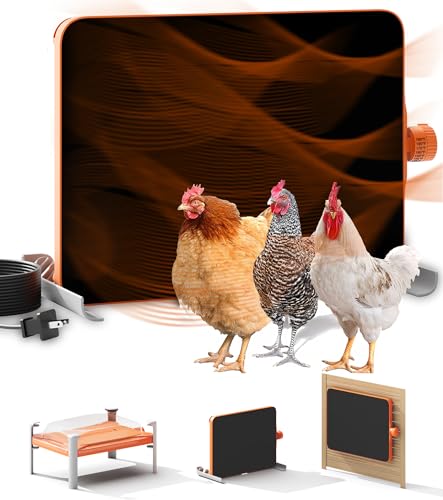
The Chickcozy Smart Coop Heater is the one for people who don’t want to think about switches at all. It has a built-in temperature sensor that adjusts the power to hold the temperature you set.
That is what makes it smart. Instead of running at full power all night, it turns itself up or down.
On a mild night it works less, and on a very cold night it works more, without you going out to the coop. Because it doesn’t have to run at full power all the time, it also makes sense for keepers who watch their electric bill.
It is a 200-watt panel, and you can set it from 70°F to 190°F. The listing gives two ranges: 70°F to 95°F for chicks and 100°F to 190°F for adult chickens. Please stay within those ranges, and don’t go above what the listing gives for your birds.
It is flexible, too. For chicks, you can lay it flat and adjust the height and angle, so it works like a brooder. For adult chickens, you mount it on the wall or let it stand.
If you raise chicks in spring and keep a flock through winter, it covers both, like the Farm Innovators 2-in-1.
The difference is the sensor: the Farm Innovators uses a switch, and the Chickcozy adjusts itself to hold your setting. If you like a set-it-and-forget-it heater, this is the one I would choose.
One more tip: write down the setting you use for your birds and tape it inside the coop door. Then everyone in the family knows the right number, even if someone else does the chores.
What I like:
- A built-in sensor that holds your set temperature.
- Works for chicks and adult chickens.
- Lay it flat, wall mount or stand it.
Features:
- 200 watts.
- Built-in temperature sensor adjusts the power.
- 70°F to 190°F (chicks 70–95°F, adults 100–190°F per the listing).
- Lay flat for chicks; wall or standing for adults.
Keep in mind:
- Use the temperature ranges in the listing, and don’t go higher than it gives for your birds.
- Set it up and check it in daylight before the first cold night, so you know how it works.
Best for: Holding a set temperature automatically
TIMEBAL 200W
Company: TIMEBAL
Price: $
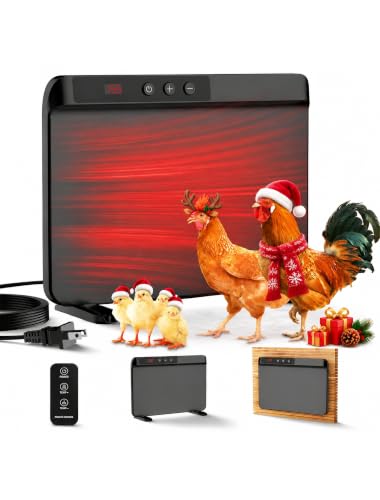
The TIMEBAL is the budget pick on my list, and it has more features than you would expect at this price. It is a 200-watt radiant panel with no bulbs.
It has an LED display and a remote, and you can set it from 122°F to 191°F. A remote sounds like a luxury, but it is handy when the heater is mounted high or behind the roosts, and you don’t want to climb in to change the setting.
The title says it is UL certified. It also has an anti-tilt auto-off: if the panel tips past 45°, it switches itself off. In a coop, where chickens flap, jump and bump into things, that is a feature I really like.
It has a memory function, so after a power outage it comes back on with your last setting. That matters on a stormy winter night, when you may not notice the power went off and came back.
It also works with outlet timers and thermostat plugs, which you buy separately. If you want it to run only at night, or only when it gets really cold, add one of those. For a low price, you get a remote, safety features and a lot of control.
For new chicken keepers on a budget, it is an easy way to get a bulb-free heater with a few extra safety features. Before the first cold night, set it up in daylight, test the remote and learn the display, so you are not doing it in the dark.
What I like:
- A remote and an LED display.
- Anti-tilt auto-off at 45°.
- Memory after a power outage.
Features:
- 200 watts, radiant panel, no bulbs.
- UL certified (per the title).
- 122°F to 191°F, LED display, remote.
- Anti-tilt auto-off at 45°, memory after a power outage.
Keep in mind:
- Timers and thermostat plugs are not included.
- Keep the remote somewhere dry, not in the coop, so it doesn’t get lost in the bedding.
Fair warning: TIMEBAL is a lesser-known brand than Cozy Products or Farm Innovators, so read the manual carefully and follow its mounting instructions.
Best for: A budget panel with a remote
Quick Comparison
| Heater | Best for | Key feature |
|---|---|---|
| Cozy Coop | Most backyard coops | 150 W flat panel, ETL-listed, thermal protector |
| Sweeter Heater OH11x40 | Even overhead heat with no hot spots | 150 W infrared, overhead, thermostat shut-off |
| Farm Innovators 2-in-1 | Keepers who raise chicks too | 200 W coop / 50 W brooder modes |
| Chickcozy Smart | Holding a set temperature automatically | 200 W, built-in sensor, 70–190°F |
| TIMEBAL 200W | A budget panel with a remote | 200 W, remote, LED display, anti-tilt off |
How I Picked These
I looked at chicken coop heaters that are easy to find right now and compared them on the things that matter in a coop: wattage, safety listings, thermal protection or auto shut-off, thermostat or sensor, how you mount them, chick modes and price.
I left out heat lamps on purpose, because of the fire risk. All the facts come from the brands’ own product information. I have not tried these heaters myself, so when a number comes from the listing, like energy use, I say so.
Do Chickens Really Need a Coop Heater?
Here is the honest answer: many backyard chicken guides say that healthy, fully feathered adult chickens usually handle cold well. Chickens wear a warm down coat, and they fluff their feathers and huddle on the roost to stay warm.
What they need most is a dry, draft-free coop with good ventilation. Damp air and drafts are usually a bigger problem than cold alone.
So when does a heater make sense? Most often in these cases:
- Extreme cold, when your winters get much colder than usual.
- Chicks, which can’t keep themselves warm yet and need a brooder.
- Sick or molting birds, which have fewer feathers or less energy.
- Frostbite-prone breeds, like birds with big combs and wattles.
If you are not sure what your flock needs, ask your vet or an experienced keeper in your area. They know your climate and your breeds.
Why I Left Out Heat Lamps
Heat lamps with 250-watt bulbs are a known coop fire risk. A hot bulb, dry straw, dust and feathers are a bad mix, and a lamp can fall if a clip slips or a bird knocks it.
That is why every pick on my list is a flat radiant panel or an overhead infrared heater, with no glowing bulbs. Several have extra safety features, like thermal protectors, auto shut-off and anti-tilt switches.
How to Choose a Chicken Coop Heater
Here are the things I would think about before you buy.
1) Wattage
The picks on my list run from 150 to 200 watts, much less than a 250-watt heat lamp. More watts means more heat but also more electricity. A small coop usually needs less than a big one.
2) Thermostat, Sensor or Switch
The Cozy Coop and Farm Innovators panels use on/off switches.
The Chickcozy has a built-in sensor that holds your set temperature, and the TIMEBAL lets you set a temperature with a remote. If your heater only has a switch, a thermostat plug made for heaters can turn it on only when it is cold.
3) Mounting
Flat panels can mount on a wall or stand on the floor, and the Farm Innovators can also hang or lie flat. The Sweeter Heater hangs overhead on a chain. Pick a spot where birds can’t roost on top of the heater.
4) Safety Features
Look for a safety listing like ETL or UL, a thermal protector or auto shut-off, and a protected cord. The TIMEBAL also switches off if it tips past 45°. These features don’t replace common sense, but they add a layer of protection.
5) Chicks or Adult Birds
If you raise chicks, a 2-in-1 heater saves you from buying a separate brooder. The Farm Innovators and the Chickcozy both work for chicks and adults.
6) Price
The TIMEBAL is the budget pick, the Cozy Coop, Farm Innovators and Chickcozy sit in the middle, and the Sweeter Heater is the premium choice.
Where to Put a Coop Heater
Mount it near the roost, but not right under it or where birds can perch on it. Your chickens should be able to move closer to the heat or away from it. That way, every bird can find a spot that feels right.
Keep straw, shavings and nesting material away from the heater, and don’t let bedding pile up against it. Follow the brand’s instructions for mounting and distance.
Keep the Coop Dry and Ventilated
Even with a heater, your coop still needs ventilation. Chickens breathe out a lot of moisture, and their droppings add more. Without fresh air, that moisture builds up, and a damp coop feels colder.
Vents up high, above the roost, let moist air escape without a draft blowing on your birds. Don’t seal the coop tight to keep the heat in.
Coop Heater Safety Checklist
- Check the heater’s safety listing and follow the manual.
- Keep cords away from pecking beaks, and run them where birds and rodents can’t reach.
- Use only an outdoor-rated extension cord, and don’t chain several cords together.
- Dust off the panel often. Coops are dusty, and dust on a heater is not a good idea.
- Check the cord and plug every week for cracks or chew marks, and stop using it if you see damage.
- Keep bedding, straw and feathers away from the heater.
Winter Chicken Care Tips
Your flock also needs fresh water that doesn’t freeze, so look at my best heated chicken waterers. Check on your birds every day, look for drafts and wet bedding, and add fresh, dry bedding when it gets damp.
Keeping other animals warm this winter too? See my heated dog houses and heaters and heated water buckets for horses.
Chicken Coop Heater FAQ
1) Question: Do Chickens Need a Heater in Winter?
Answer:
Not always. Many backyard chicken guides say healthy, fully feathered adult chickens usually do fine in a dry, draft-free, ventilated coop. A heater helps in extreme cold, for chicks and for sick, molting or frostbite-prone birds. Ask your vet if you are not sure.
2) Question: What Is the Safest Way to Heat a Chicken Coop?
Answer:
Choose a flat radiant panel or another heater made for coops, with a safety listing and a thermal protector or auto shut-off, instead of a heat lamp. Mount it securely, keep bedding away and follow the manual.
3) Question: Are Heat Lamps Safe for Chicken Coops?
Answer:
Heat lamps with 250-watt bulbs are a known coop fire risk, because hot bulbs sit near dry straw, dust and feathers. That is why I only picked flat panels and an overhead infrared heater.
4) Question: How Much Electricity Does a Coop Heater Use?
Answer:
The heaters on my list use 150 to 200 watts. The Cozy Coop listing says it uses about 13% of the energy of a 1,500-watt space heater. A thermostat plug or a heater with a sensor helps, because it only runs when needed.
5) Question: Does a Coop Heater Need a Thermostat?
Answer:
It is not required, but it helps. The Chickcozy has a built-in sensor, and the TIMEBAL works with thermostat plugs. For heaters with only a switch, a thermostat plug made for heaters can turn them on when it gets cold.
6) Question: Can I Use a Coop Heater for Chicks?
Answer:
Some, yes. The Farm Innovators 2-in-1 has a 50-watt brooder mode, and the Chickcozy can lie flat for chicks. Follow the listing’s settings, and watch how your chicks behave under it.
7) Question: Should I Leave the Coop Heater On All Night?
Answer:
Many keepers do on the coldest nights. A heater with a sensor, or one on a thermostat plug, runs only when it is needed. Always follow the manual.
8) Question: Where Should I Put the Heater in the Coop?
Answer:
Near the roost, but not where birds can perch on it, and away from bedding and nesting boxes. Leave room for your chickens to move closer or farther away.
9) Question: Do I Still Need Ventilation With a Heater?
Answer:
Yes. A heated coop still needs fresh air, because moisture from breath and droppings makes a coop damp. Vents up high, above the roost, are a common choice.
10) Question: Is a Solar Chicken Coop Heater a Good Idea?
Answer:
Solar is popular with keepers who don’t have power at the coop. I didn’t include any solar heaters on this list, so check the details of any model carefully before you buy.
11) Question: How Do I Heat a Chicken Coop Without Electricity?
Answer:
Most keepers focus on keeping the coop dry and draft-free, with good ventilation, thick dry bedding and a well-built coop. Chickens huddle together on the roost and keep each other warm.
12) Question: Can a Heater Prevent Frostbite?
Answer:
I can’t promise that. Frostbite is a health question, so ask your vet. A dry coop with good ventilation is the advice you will hear most often from experienced keepers.
Conclusion
A safe coop heater can make the coldest nights easier for your flock, as long as you still keep the coop dry, draft-free and ventilated.
For most backyard coops, my top pick is the Cozy Coop. If you raise chicks too, look at the Farm Innovators 2-in-1 or the Chickcozy Smart, for even overhead heat the Sweeter Heater, and for a budget panel with a remote, the TIMEBAL.
I hope this best chicken coop heaters 2027 list helped you choose. Feeding wild birds in winter too? See my best heated bird baths. Let me know in the comments how you keep your flock warm.
About Author

Kate Janelle
Photography enthusiast and creator at Digital World Beauty. My main objective is to create a valuable resource for you with honest tech gear reviews, course recommendations, and how-to tutorials.